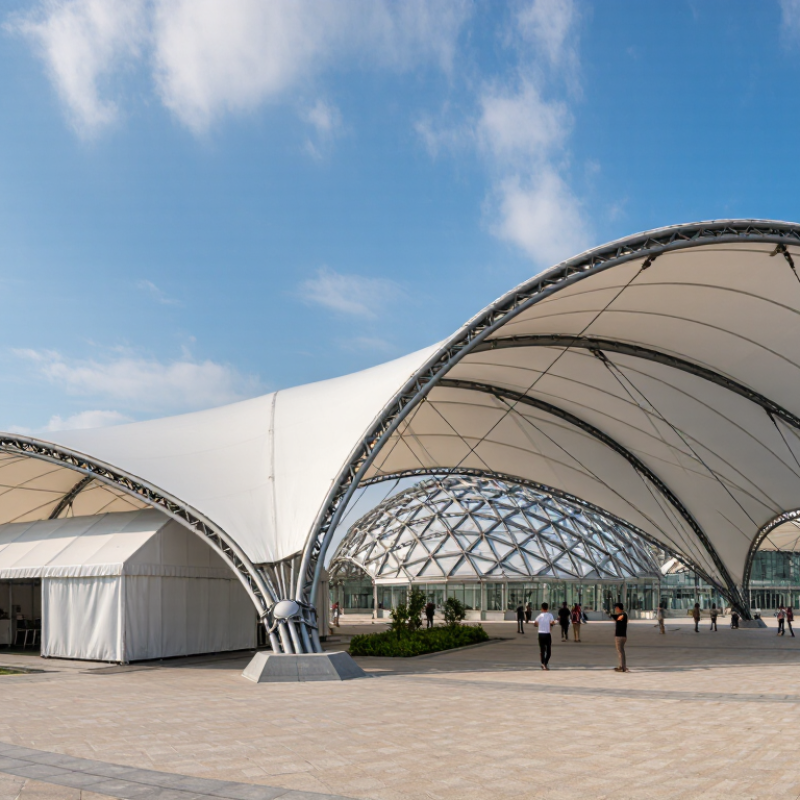
Choosing a Membrane Structure Tent is not simply a matter of selecting an attractive shape. The right decision connects site conditions, engineering performance, user comfort, and long-term maintenance. A tent beside a windy coastline faces different demands from one used for a quiet garden wedding. Wind pressure, snow load, ultraviolet exposure, drainage, fire performance, and local permits all deserve careful review.
Frei Otto, a pioneer of lightweight and tensile architecture, described architecture as “the art of reconciliation between ourselves and the world.” His idea remains practical here. A successful membrane structure should respond to its environment, not fight it. PVC-coated polyester may suit many temporary applications, while PTFE-coated fiberglass can provide longer service and stronger resistance to heat and weather. ETFE offers a different balance of transparency, weight, and cost. None is automatically the best choice.
Look closely at the details. Check the fabric specification, connector quality, anchoring method, ventilation plan, and snow or wind calculations. Ask whether the supplier has completed similar projects in comparable climates. Request engineering documents, maintenance guidance, warranty terms, and fire-test evidence. Independent review is valuable, especially for large public installations.
There is no perfect checklist.
Even experienced buyers can focus too heavily on appearance. I have seen elegant concepts become uncomfortable because of glare, trapped heat, or poor rainwater control. This guide will examine the decisions that matter, while admitting one uncomfortable truth: budget pressure can quietly weaken an otherwise sound selection.
How to Choose a Membrane Structure Tent?
Classify membrane tents by PVC, PTFE, and ETFE performance, not appearance alone. PVC-coated polyester is usually the practical starting point. Industry guidance from the International Association for Shell and Spatial Structures reports typical service lives of about 15–25 years, depending on coating quality, climate, and maintenance. Its visible-light transmission often falls near 5–15%, creating comfortable shade beneath a canopy. However, dirt can collect on the surface, and plasticizer migration may reduce flexibility over time. That detail is easy to miss.
PTFE-coated glass fiber fabric generally serves for more than 30 years in demanding outdoor applications, according to membrane engineering references used by professional structural designers. It offers strong ultraviolet resistance and low surface adhesion. Light transmission commonly ranges from 10–20%, producing a bright but controlled interior. The material costs more and requires tighter fabrication control. I would not choose it only because it lasts longer. Installation errors can still weaken the system.
ETFE film provides a different performance profile. Technical data reviewed in the European building-envelope sector commonly records visible-light transmission around 90–95%. It is lightweight and useful when daylight is a design priority. Multi-layer cushions can also improve insulation, though their thermal performance depends on pressure, geometry, and climate. ETFE may need cleaning after dust storms or heavy pollen seasons. No material wins every site. A 2023 ASHRAE Handbook approach also supports evaluating solar gain, ventilation, and local weather together, rather than selecting a membrane from headline figures alone.
PVC-coated polyester is commonly selected for cost efficiency and practical service life. PTFE-coated fiberglass generally provides longer durability and strong weather resistance, while ETFE foil offers exceptional daylight transmission and a lightweight structure. The values shown are representative industry ranges expressed as typical midpoint estimates; actual performance depends on material grade, climate, detailing, maintenance, and structural design.
Choosing a membrane structure tent starts with span, occupancy, and expected service life. PVC-coated polyester covers typically reach 15–25 years in ordinary outdoor conditions, according to technical guidance from the European Coated Fabrics Association. That range assumes proper tension, drainage, cleaning, and routine inspection. It is not a promise.
A wider tent demands more than extra fabric. Span affects membrane stress, cable forces, snow loads, and wind uplift. Design teams should verify these actions under EN 1991-1-3, EN 1991-1-4, and local structural requirements. EN 15619 also addresses coated fabrics used in temporary and permanent structures. A crowded event tent needs clear load paths, safe exits, and adequate headroom. Capacity must match the actual seating plan, not an optimistic estimate.
The cover’s environment matters greatly. Strong ultraviolet exposure, standing water, pollution, and repeated folding can shorten its useful life. A PVDF surface treatment may improve weather resistance and cleanability, but it cannot correct poor detailing. I would question any simple “20-year” claim without maintenance records and climate assumptions. Inspect seams, edge cables, drainage valleys, and coating wear every year. Small cracks are easy to ignore. They should not be. A practical selection should compare the required span, peak occupancy, local wind and snow data, and the realistic 15–25-year replacement cycle.
Wind and snow resistance should begin with local design loads, not fabric appearance. ASCE 7-22 uses site-specific wind maps and a 700-year mean recurrence interval for many ultimate wind speeds. That value is not a universal wind rating for every tent. Terrain, elevation, exposure, enclosure, and importance category can change the result. Ask the supplier for structural calculations that identify these assumptions clearly.
Snow requires equal care. ASCE 7-22 generally uses mapped ground snow loads with a 50-year recurrence basis, while EN 1991-1-3 requires national or regional snow data. The roof design must consider drifting, unbalanced snow, sliding snow, and ponding after partial melting. A membrane may look flexible, but its cables, anchors, joints, and frame connections still need verified load paths. In practical reviews, anchor capacity is often treated too simply. Soil strength and installation quality can undermine an otherwise sound calculation.
Tips: Request the governing local code, wind speed, snow load, load combinations, and deflection limits. Check whether calculations cover temporary construction stages. Ask for the engineer’s license and calculation date. Do not accept “tested for extreme weather” without numbers. A better question is: “What load can this exact site resist?” Record the answer. Conditions change.
How to Choose a Membrane Structure Tent?
Fire performance should guide your tent selection, not fabric appearance. EN 13501-1 classifies construction products from A1 to F. It also records smoke production and flaming droplets, using ratings such as s1 and d0. For a membrane tent, request the complete test report. Check the exact coated fabric, seams, tension, and supporting structure. A certificate for loose fabric may not represent the installed roof. This detail is often missed.
NFPA 701 uses pass-or-fail test methods for textiles and films. It is not an A-to-F classification system. Test Method 1 commonly addresses smaller specimens, while Test Method 2 evaluates larger textile or film applications. Confirm which method matches your tent design and local approval requirements. NFPA reported approximately 1.39 million fires in the United States during 2023. That figure does not predict tent fires, but it shows why ignition control deserves serious attention. Fire ratings cannot replace safe heaters, clear exits, and trained staff.
Tips: Ask for current, third-party laboratory reports. Match the report to the final membrane assembly. Verify EN 13501-1 results with the project authority. Confirm whether NFPA 701 testing covers the intended fabric use. Keep certificates with inspection records. A test report alone is not enough. In practice, installation quality can weaken otherwise strong fire performance, and that uncomfortable possibility deserves regular review.
| Selection Dimension | EN 13501-1 | NFPA 701 | What to Check for a Membrane Structure Tent | Selection Guidance |
|---|---|---|---|---|
| Standard Purpose | European classification system for the reaction-to-fire performance of construction products and building elements, subject to the applicable product scope. | Test standard for the flammability of textiles, films, coated fabrics and similar materials used in applications such as interior furnishings, awnings and temporary structures. | Confirm that the test report applies to the actual membrane material, coating, color, weight, support condition and intended installation. | Do not treat the two standards as interchangeable; request the standard required by the project authority or local code. |
| Rating Format | Class A1–F May include smoke classification s1–s3 and flaming-droplet classification d0–d2. | Pass / Fail The result is normally reported for the applicable test method and specimen configuration rather than as an A–F class. | Obtain the complete classification or test result, not only a statement such as “fire retardant.” | Prefer documentation that clearly identifies the tested product construction and its limitations. |
| EN Class A1 | No contribution to fire under the relevant classification conditions. This is an exceptional classification and should not be assumed for polymer-coated fabrics. | No direct equivalent. NFPA 701 does not create an A1-equivalent class. | Check whether the membrane is genuinely within the scope of the A1 classification and whether the supporting substrate or complete assembly changes the result. | Use only when specifically required and supported by valid product documentation. |
| EN Class A2 | Very limited contribution to fire. A smoke suffix and, where applicable, a droplet suffix may accompany the class. | No direct equivalent. A material passing NFPA 701 cannot automatically be described as EN A2. | Request the full designation, for example the applicable A2-s1,d0 type format where formally issued for the product. | Useful for projects with strict European reaction-to-fire requirements, subject to the product’s classification scope. |
| EN Classes B and C | Limited contribution to fire. The exact classification depends on the applicable test results and may include smoke and droplet suffixes. | No direct class-to-class conversion is permitted. | Verify whether the classification covers the membrane as installed, including tensioning, seams, insulation, liners and adjacent components. | Often relevant where a controlled level of reaction-to-fire performance is required, but acceptance remains project-specific. |
| EN Classes D and E | Medium contribution to fire for Class D; acceptable reaction to fire under the applicable test conditions for Class E. | No direct equivalent. A passing NFPA 701 result does not establish EN Class D or E. | Determine whether the rating is sufficient for the occupancy, evacuation strategy, tent size and local building regulations. | Do not select solely on the basis of a passing textile test when a European classification is required. |
| EN Class F | No performance determined or the product does not achieve the higher classifications under the applicable assessment. | A material may still pass or fail NFPA 701; the results are separate. | Ask for a current test report before approving the material for public occupancy or enclosed use. | Generally unsuitable where a documented fire-performance classification is mandatory. |
| Smoke Production | s1: lower smoke production; s2: intermediate smoke production; s3: no smoke-performance limit specified by the classification system. | NFPA 701 is not an EN smoke-classification system and does not provide s1–s3 ratings. | For enclosed or crowded tents, consider smoke movement, ventilation, emergency lighting and evacuation visibility in addition to flame spread. | Where smoke control is important, request the complete EN designation and project-specific fire-engineering review. |
| Flaming Droplets or Particles | d0: no flaming droplets or particles; d1: limited duration; d2: no performance determined or failure of the relevant criterion. | No direct d0–d2 equivalent is provided by NFPA 701. | Consider overhead ignition hazards, combustible furnishings and the consequences of burning droplets falling onto occupants or escape routes. | Give additional attention to roof membranes, translucent panels and suspended liners. |
| NFPA 701 Method Selection | Uses the applicable European reaction-to-fire test and classification procedures for the product type and end use. | NFPA 701 includes different test methods for different material types, constructions and applications. The applicable method must be selected from the current edition and project scope. | Confirm the method number, edition, specimen orientation, mounting arrangement, conditioning and whether the report covers the complete membrane assembly. | Never rely on “NFPA 701 tested” without the method and test-report details. |
| Material Construction | Classification can depend on the complete product construction, including base fabric, polymer coating, surface treatment and backing. | Results can vary with fabric weight, coating, finish, seams, edge treatment and specimen preparation. | Match the certificate to the supplied material’s base cloth, coating system, thickness, color and production specification. | A change in coating, pigment, surface finish or fabrication may require a new assessment. |
| Installation and Assembly | A product classification may not automatically cover the entire tent assembly or installed system. | Passing material tests does not evaluate every installed condition, including overlaps, zippers, ropes, cables, insulation, liners or attached decorations. | Review membrane joints, supports, internal linings, flooring, doors, partitions, lighting and heating equipment as a complete system. | Obtain assembly-level approval when required by the authority having jurisdiction. |
| Weathering and Maintenance | Fire performance may be affected by ageing, ultraviolet exposure, moisture, dirt, cleaning chemicals and repeated folding. | The test result represents the submitted specimen and conditioning stated in the report; field performance can change with service conditions. | Ask for cleaning instructions, inspection intervals, repair procedures and evidence of durability where the tent is used repeatedly or outdoors. | Schedule inspections and replace damaged, contaminated or heavily worn membrane sections. |
| Documentation to Request | Complete classification report showing the standard, edition, classification, test methods, specimen description and scope of application. | Complete report showing NFPA 701 edition, applicable method, specimen details, conditioning, observations and pass/fail result. | Request technical data sheets, certificates, test reports, installation limits, flame-retardant treatment information and inspection records. | Use traceable, current documentation that identifies the exact material supplied for the project. |
| Best Practical Choice | Choose the highest classification that is required and accepted for the project, with the full smoke and droplet suffixes where applicable. | Choose a material that passes the applicable NFPA 701 method required for the intended temporary-structure application. | Combine documented membrane performance with safe exits, emergency lighting, fire extinguishers, occupancy controls and compliant heating and electrical systems. | Fire rating is only one part of a complete tent fire-safety strategy. |

Important: EN 13501-1 classifications and NFPA 701 results are not directly convertible. A passing result under one standard does not automatically satisfy the other.
Verification: Requirements can vary by country, occupancy, tent size, public access, duration of use and authority having jurisdiction. Confirm the applicable current edition and local acceptance criteria before procurement.
Scope: The final approval should be based on the exact membrane construction and the complete installed tent system, not on a generic material description.
How to Choose a Membrane Structure Tent?
Installation decisions shape the tent’s entire service life. Review soil conditions, access routes, crane positions, and drainage before approving drawings. EN 13782 requires temporary structures to address wind, snow, stability, and evacuation conditions. A small anchoring mistake can create expensive site delays. It happens more often than expected.
Maintenance deserves a realistic schedule, not optimistic promises. Industry guidance from IFAI’s Fabric Structures Association commonly places PVC-coated polyester membranes around 15–20 years, while PTFE-coated glass-fiber systems may exceed 25–30 years. Actual life depends on ultraviolet exposure, pollution, cleaning, tension, and repair quality. Inspect seams, cables, gutters, and anchor points at least twice yearly. Look closely after severe weather. Dust around a drain can reveal a larger problem.
Life-cycle cost should follow ISO 15686-5 and RICS Life Cycle Costing principles. Compare purchase, transport, installation, cleaning, inspections, repairs, replacement, energy use, and removal. A cheaper membrane may require earlier replacement, disrupting events and increasing labor costs. A durable system may reduce intervention, but its installation can demand heavier lifting equipment. Use local labor rates and realistic weather assumptions. The spreadsheet will still be imperfect. Recheck it with a contractor’s maintenance records, not only supplier estimates.